This article may contain affiliate links. For more details, please refer to our disclosure.
Coming to Japan for the first time, you might feel unsure about how to ride the trains or how to pay. A Suica card takes care of most of that. One card works for trains, buses, and convenience stores.
This guide covers everything you need to get started. If you already have a Welcome Suica, this applies to you too. Both cards work exactly the same way.
What Is a Suica Card and Why You Need It
Suica is a prepaid IC card that works across Japan. Other IC cards exist, such as PASMO and ICOCA, but they all work in the same way. Suica is the most widely used.
What you can pay for with Suica
Suica works on JR* trains, subways, private railways, and buses. Just tap your card at the gate to get on. No need to buy a ticket for each journey.
*JR= Japan Railways
It also works at convenience stores, vending machines, and drugstores. Some shops and coin lockers inside stations accept it too.
Suica vs. Cash
| Suica | Cash | |
|---|---|---|
| Buying a ticket | Not needed (go straight to the gate) | Buy at the ticket machine |
| Checking the fare | Not needed (calculated automatically) | Check the route map and fare list |
| Transfers | Tap and go | Calculate fares carefully |
| Paying at shops | One tap, no change needed | Hand over cash and wait for change |
One card covers both transport and everyday payments, so you can travel with less cash. Having Suica makes getting around much smoother.
Welcome Suica or Suica: Which One Should You Get?
Suica comes in two versions: Welcome Suica, made for visitors to Japan, and standard Suica. They work the same way, but the conditions are different.
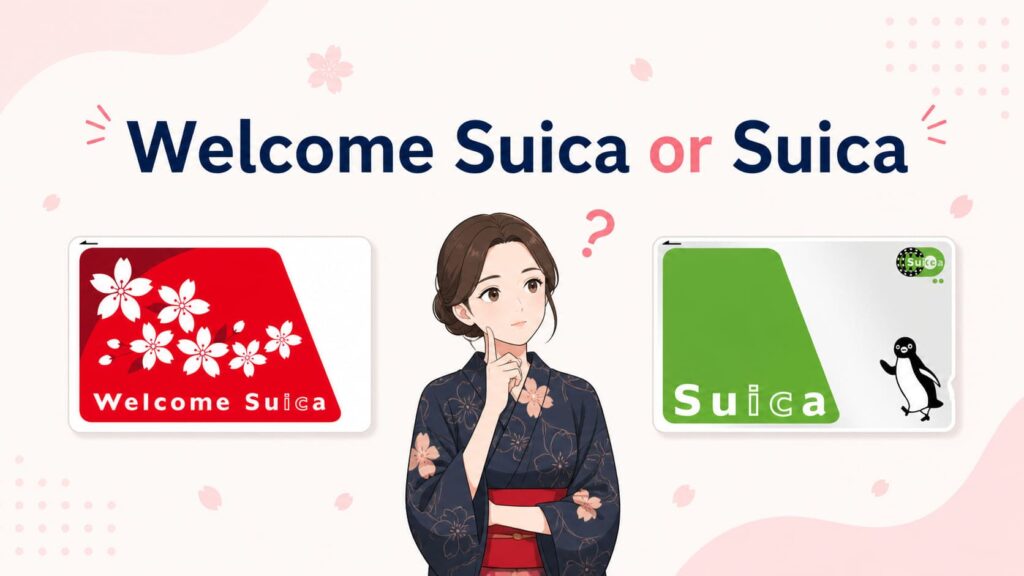
Welcome Suica vs. Suica
| Welcome Suica | Suica | |
|---|---|---|
| Best for | Short-term visitors (under 1 month) | Long stays and repeat visitors |
| Deposit | Not required | ¥500 required |
| Valid for | 28 days from purchase | Balance stays valid for years |
| Refund | Not available | Available (handling fee applies) |
Choose Welcome Suica if…
For stays of 28 days or less, Welcome Suica (the red card) is a simple option. No deposit needed. The amount you load goes straight onto the card.
The card is valid for 28 days from purchase. Refunds are not available, so try to use up your balance before you leave. You can keep the card as a souvenir after your trip.
Choose Suica if…
For longer stays or if you plan to visit Japan again, the standard Suica (the green card) is worth getting. A ¥500 deposit is required, but your balance stays valid for years.
If you no longer need the card, you can return it at a JR ticket office for a refund, minus a handling fee.
Note: How you use and top up both cards is exactly the same.
Where and How to Get a Suica Card
Both the Welcome Suica and Suica are available at airports and major stations.
| Welcome Suica | Suica | |
|---|---|---|
| Where to buy | Airports and select JR facilities | Major JR stations |
| How to buy | Dedicated machine or counter | Ticket machine or ticket office |
| Payment at purchase | Top-up amount only | ¥500 deposit + top-up amount |
| Mobile app | Available (iOS only) | iOS / Android (Japan-market phones only) |
Where to Buy Welcome Suica
Welcome Suica is available at the following locations.
Welcome Suica dedicated machine
- Narita Airport Station, Narita Airport Terminal 2 Station
- Haneda Airport Terminal 3 Station
JR East Service Center/JAPAN RAIL CAFÉ
- Narita Airport Station, Narita Airport Terminal 2 Station
- Haneda Airport Terminal 3 Station
- Stations: Tokyo, Shinjuku, Shibuya, Ikebukuro, Ueno, Yokohama, Sendai, Takanawa Gateway
For the full and up-to-date list of locations, check the official JR East site. → Welcome Suica Purchasing and Using (JR East official)
Where to Buy Suica
Standard Suica is available at JR East stations in eastern Japan. Look for a multi-function ticket machine (the black machine with the Suica mark) or visit the JR ticket office. Major stations such as Tokyo, Shinjuku, Shibuya, and Ikebukuro all have both options.
Suica Card Price
Welcome Suica has no deposit. The amount you pay goes straight onto the card.
Standard Suica requires a ¥500 deposit on top of the amount you load. For example, loading ¥1,000 means you pay ¥1,500 in total. The deposit is refunded when you return the card, minus a handling fee.
Both cards are available in the following amounts:
| Price |
|---|
| ¥1,000 |
| ¥2,000 |
| ¥3,000 |
| ¥4,000 |
| ¥5,000 |
| ¥10,000 |
Not sure how much to load? Starting with ¥3,000 to ¥5,000 is a good amount for most trips. You can always top up later.
Physical Card or Digital Suica (Mobile Suica)?
Both cards are also available as a digital version on your smartphone.
- iPhone users can add Suica to Apple Wallet. The Welcome Suica Mobile app is valid for 180 days and can be set up before you arrive in Japan.
- Android users: the app works only on phones sold in Japan. If your phone was purchased outside Japan, a physical card is the safer option.
How to Use Your Suica Card in Japan
With Suica, you can enter stations, ride trains and buses, and pay your fare with a single tap. No tickets needed.
On Trains and Subways
Tap your card on the reader at the ticket gate to enter. Tap again when you exit, and the fare is calculated and deducted automatically.
No need to look up fares for each journey. Just tap in and tap out.
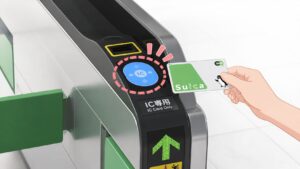
If your balance is too low, the gate will not open when you try to exit. If that happens, go back inside and use the fare adjustment machine to pay the difference. These machines are usually located near the ticket gates.
On Buses
On buses, tap your card when boarding or when getting off. This varies depending on the route and region. The fare is calculated automatically, so no need to check the fare chart. It is quicker and easier than paying with cash.
At Convenience Stores, Shops and Vending Machines
At the register, tap your card on the reader to pay. You can also say “Suica” to let the cashier know. At vending machines, just tap your card to buy. No coins needed, and checkout is fast.
Checking Your Balance
Your balance is shown on the screen each time you pass through a ticket gate. You can also check it at any ticket machine or top-up machine. If your balance runs low, the gate will stop you, so it is a good idea to check before you travel.
How to Top Up Your Suica Card
Suica is a prepaid card. You add money to it and spend from the balance. The maximum balance is ¥20,000.
At a Ticket Machine
- Select your language on the screen.
- Insert your card.
- Select “Charge,” and choose an amount.
- Insert cash.
Note: Only cash is accepted. No credit cards.
The machines support multiple languages including English, so the process is straightforward. Ticket machines are located near the ticket gates at most stations.
On Your iPhone (Suica App)
If you are using the digital version of Suica on your iPhone, you can top up through Apple Wallet or the Suica app using a credit card.
Important Things to Know
There are a few situations where Suica does not work, and some things worth knowing before you travel.

Where Suica Does Not Work
Suica cannot be used on its own for Shinkansen (bullet train) travel. A separate ticket is required.
Some local railways and buses outside major cities may not accept Suica. It is worth checking before you travel on unfamiliar routes.
Refunds and Lost Cards
Welcome Suica cannot be refunded. Try to use up the remaining balance before you leave.
Standard Suica can be returned at a JR ticket office. You will receive the remaining balance minus a handling fee.
If you lose an unregisterd card, the balance cannot be recovered. Only registered cards can be reissued.
Summary
With a Suica card, you can handle both transport and everyday payments with a single card.
It reduces the need for cash and saves you from buying tickets at every stop.
Pick one up at Haneda or Narita Airport, or at a major station, load some money, and you are ready to go. Enjoy your trip in Japan.