This article may contain affiliate links. For more details, please refer to our disclosure.
Before you pack your hair dryer for Japan, it’s worth checking one thing: the voltage label.
Japan runs on 100V, and most countries use 110–120V or 220–240V. A quick look at the label on your dryer will tell you in seconds whether it will work here.
Japan’s Voltage: The Basics
Japan uses 100V at 50–60Hz. Most countries in Asia, Europe, and Australia use 220–240V, while the US and Canada run on 120V.
For most electronics, a small voltage difference doesn’t cause problems. Hair dryers are more sensitive to it, because the heating element relies on the right amount of power. A dryer running on the wrong voltage may not heat up properly, or it may overheat over time.
How to Check Your Hair Dryer
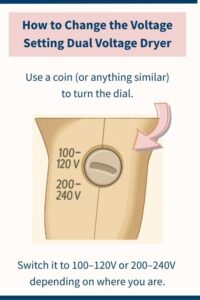
The voltage information is printed on the handle, near the plug, or on a small label close to the cord. Look for one of these:
- 100–240V: dual voltage. This dryer works in Japan and most other countries.
- 100V: Japan only. It will not work properly abroad.
- 220–240V: not made for Japan. It may underperform or fail here.
Plug Types and Voltage by Country
Japan uses Type A plugs: two flat parallel pins, similar to the US and Canada. If your plug shape is different, you’ll need a travel adapter.
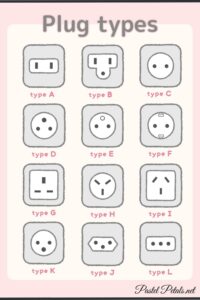
Keep in mind that an adapter only changes the plug shape. It does not convert the voltage.
| Country/Region | Voltage (V) | Plug Type |
|---|---|---|
| United States / Canada | 120 | A, B |
| Japan | 100 | A |
| South Korea | 220 | C, F |
| China | 220 | A, C, I |
| Hong Kong | 220 | G |
| Taiwan | 110 | A, B |
| Malaysia | 230 | G |
| Singapore | 230 | G |
| Australia | 230 | I |
| United Kingdom | 230 | G |
| Germany/ Spain | 230 | C, F |
Can You Use Your Hair Dryer in Japan?
If Your Dryer Says 100–240V
A dual voltage dryer handles the full range, so Japan’s 100V is within spec. You may need a plug adapter if your plug type doesn’t fit Japan’s Type A sockets, but the dryer itself will work fine.
If Your Dryer Is 220–240V Only
It’s unlikely to heat up well at 100V, and running it this way over time can wear out the motor faster. In most cases, though, it’s easier to leave it at home.
Most hotels in Japan, including budget options, provide a dryer in the room. Many Airbnbs do too. Unless you’re staying somewhere very basic, you’ll probably find one waiting for you.
Buying a Hair Dryer in Japan
Japanese dryers have a good reputation, and you’ll find them everywhere from large electronics stores to neighborhood drugstores. The price range is wide, from affordable travel models to high-end home dryers.
One thing to watch for: most models on the shelves are made for Japan’s 100V only. If you plan to use it back home, check the label before you buy. Dual voltage models are available, but they’re not the majority.
Panasonic
Panasonic is the most widely trusted dryer brand in Japan. I use a Panasonic dryer myself, and the Nanoe technology does make a noticeable difference. Hair feels less dry after blow-drying compared to a standard dryer.
Their dual voltage option is the EH-NA9F, which covers both 100–120V and 200–240V. It comes with a C-2 adapter for use in countries with different plug shapes.
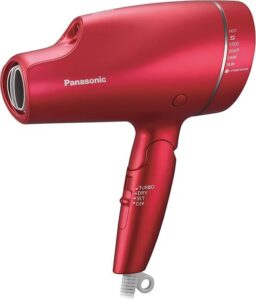
Panasonic EH-NA9F – Key Features
- Dual voltage (AC100–120V / 200–240V, 50–60Hz
- Standard A-type plug (Japan), with C-2 plug adapter included
- Nanoe & Mineral + Negative Ion technology for hair care
- UV protection to reduce hair damage from sunlight
- Cuticle sealing for smoother, shinier hair
- Anti-static control for less frizz
- Multiple drying modes: hot–cold rhythm, scalp mode, and more
Source: Panasonic Official Website
Koizumi
Koizumi’s dual voltage hair dryers are affordable and portable, making them a good choice for travelers who want something easy to carry home.
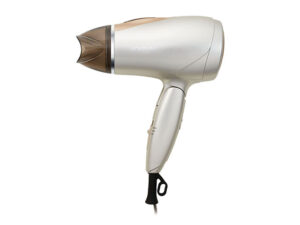
Koizumi KDD-0020/N – Key Features
- Dual voltage (AC100–120V / 200–240V)
- Twin negative ion outlets for smoother hair
- Lightweight design (approx. 410g)
- Foldable handle for compact storage
- Safety system to prevent hair from getting caught in the fan
- Two heat settings: HIGH / LOW
Source: Koizumi Official Website
Summary: Voltage Compatibility for Japanese Hair Dryers
Japan’s 100V standard is lower than most other countries, but it’s easy to work around once you know what to check. If your dryer label shows 100–240V, you’re fine to bring it. If it’s 220–240V only, it’s usually simpler to leave it behind. Hotels and most rentals here provide one.
If you’re thinking of buying a dryer while you’re here, Panasonic and Koizumi both have dual voltage options worth looking at. Just confirm the label before you buy.